Sunday, May 3, 2009


Social production in the old economy was simple, in that most areas of exchange dealt with tangible goods. For example, many people in the old economy were workers in factories because with that time in history, is what the United States had exceeded itself in producing. With the rise of the internet not just as surface, but as an interface, people took advantage of this new module of communication in early 2000. Compainies such as Ebay, Google, and eventually social networking sites like Myspace and Facebook brought a new media, as well as a new form of social production into existence.

Shopping, for most people, is now done online because of the convenience. Many people are also able to work from home, because of greater advances in technology and a more common understanding of how to effectively use these tools. What does this have to do with the everyday person?

We are now living in what will likely be dubbed the “Information Age”. Just in the past 10 years, our society has shifted from an industrial economy, to an information and knowledge economy. One may be a very dedicated worker, but with the changing of what might be considered “wealth” in this country and across most of the world, it seems to be all about who you know. By this I mean how well one can network their connections in order to advance in the workforce/society in general.

Commodities have been created, whereas people can go to an online source for almost anything they want or need. This may involve financial capital, or not. People log onto Myspace and Facebook and other online forums to share information either because they get either personal satisfaction or a greater sense of self worth from it. Nobody forces anybody else to spend time online, but it is obviously self imposed.

An article entitled “New Study Shows Time Spent Online Important for Teen Development,” explains how teenagers can benefit from spending time on the internet. According to the article, “spending time online is essential for young people to pick up the social and technical skills they need to be competent citizens in the digital age.” This article is based on a study done over a period of 3 years, and released in 2008 by the American Anthropological Association.

Sunday, April 26, 2009

Marketing Yourself


Online communities almost market themselves on the idea of “connecting” with people. Facebook, now the cliché example, is a good example of how individuals interact with other individuals online. Technically, anybody can be anybody elses friend with the accepting persons approval. Another benefit of websites like Facebook and Myspace (Facebook to a larger degree) is that you can find old friends/contacts, and ultimately add them to your friends list. This scenario can cause problems on a larger scale.

Even though one can accept/deny requests as one of Facebook’s privacy options, more complicated factors may come into play. For example, if someone might happen to know the requester in an “offline” relationship of some kind, a refusal to accept the friendship request could cause real life awkward and social tensions. Surely that person would want to know why the person they requested to be Facebook friends with had turned them down. This could bring up unwarranted animosity between people by bringing together peoples work/school and private lives.

Social networking sites, especially Facebook and Myspace where the “friending” aspect is most used, are being used as “relationship monitors” for many. Numerous examples can be given about middle and high school kids starting real physical confrontations about either rumors or personal materials on these sites. The article below from November 18, 2008, goes into more detail about how real social anxieties can be brought out through the online world.


The internet has made an enormous headway in turning itself into a modern, technological marketplace. In this case, social capital being the main product for the consumer to take in. If social capital is a concept of not just how many contacts or “friends” someone has, but rather what one can make out of those ties, then can we use these online public spheres into something useful for our forward social mobilization? It may depend on how well we can market ourselves, and time will tell.


Monday, April 13, 2009

Social Skills Online...


Social skill is something we all had to, or must go through to gain connections for our social networks. Most often, the cliché example is children learning how to interact with other children in the “playground” scenario. Since technology has been greatly implemented in our everyday lives, it gives reason to suggest that kids are going to take part in exploring new information, as well as others and themselves online.

Class rooms across the country are constantly changing the way they approach education mixed with technological advances. For example, many schools have online ways of interacting with classmates and teachers through means of blackboard, blogging, and other variations of FDU’s web campus feature. Others question the method of teaching through online resources because of the fear of not equipping children and teens with adequate social skills that would prepare them for adulthood. Even the workplace has vast amounts of technology supporting the way business is done across the world. Can children and teens be ignorant of how to apply these new technologies to their future careers?

Social skills result from ones associations, networks, but most importantly the trust holding those networks together. These factors are all dependent upon each other, and rely on each other to advance in society. In the “public spheres” of Myspace and Facebook people can play different roles depending on what their specific intentions are, but for most children and teens that is maintaining their social capital. There are certain etiquettes which go along with any online community that take onto social networking sites, but usually never stray from their own circle of friends. In other words, they are voluntarily putting themselves on display to their peers to broadcast how they want to be seen.

An article from ABC News entitled “Study: Kids developing social skills online”. The author, Ravi Baichwal, discusses how online tools may be a benefit to those kids who are growing up in an already technologically globalized world. One of the arguments for this is that parents have to be in tune enough to monitor how much time/what their child is doing online. The idea is that the more versed in online communication someone is, the higher the likelihood that they would advance in a future career.


Saturday, April 4, 2009

Big Brother Surveillance


Surveillance is now an everyday part of our society. Almost everywhere someone goes, there can certainly be a possibility of them being recorded or monitored by video/digital surveillance. What started as a “new” trend in the 1990’s, in a post 911 world, is now seen as a mandatory strategy for the security of the country.

The idea of constant surveillance derives from “panoptic surveillance”, which is the notion that if the public feels they are being watched, then they will curb their natural behaviors and obey the laws. The “Opticon” reveals the sociology behind this method of security, whereby the structural design of a guard tower where the prisoners cannot see inside the tower, erodes their sense of freedom. Guards may not even be present in the tower, the theory being the prisoners will behave knowing they are being constantly monitored.

In cities such as London, the video surveillance has been an even greater threat to civil liberties because of the centralization of information being collected. This means that the police intercept all of the footage being recorded, and review it with facial recognition software to watch for suspected terrorists. The article below describes this concept from the British point of view, and talks about the laws being considered by European Parliaments, and even possibly in the United States.


The solution to losing our civil liberties in the name of security could not be just unless there is transparency. In order for their to be an effective law enforcement and security priority to stop terror plots and attacks, there needs to be a way that the public could watch law enforcement, watching them. Modern societies cannot be considered safe, until there is a much more highly evolved form of trust between the people, and their elected officials in the Government.


Saturday, March 28, 2009

A Virtual Commons: Public vs Private

Virtual communities were created as a “new” public sphere. The idea was to have technology help gather people, having the end result be free exchange of information and ideas. Facebook is an excellent example of this because it was literally invented by students at Harvard looking for an easier way to communicate information with their peers. This trickled down to the average college student, and as of more recently leaked down to anyone who wants to create an account and log onto the server.

Aside from the well documented losses of privacy which people voluntarily waive to become members of these sites, there is a question of the public vs. the private. The public domain is available to everyone, without imposing onto the limit of their social capital. The public domain is also free, such as a public park. The private domain is based upon the limited success of the individual. Ownership is a major component of the private sector. When something belongs to the private sector, there will be a theoretical reliance on a modern capitalist system. The private also assumes that people are “capable of rational thought”.

Online communities like Facebook and Myspcace encourage everyone to sign up and log onto their server to exchange information. The catch is that when there is enough “social capital” gained (by the number of people signing up), Facebook and Myspace might well become part of the private to extract what they need to from its members in order to advance itself. Google has even talked about owning all books in their entirety to be able to increase literacy, if not only information in the form of “online books”.
The below link leads to an article explaining the idea of basically bringing books from authors online, and as some might say, into the online public sphere.

http://everybodyslibraries.com/2009/03/18/the-google-books-settlement-a-symposium-and-a-call-for-library-action/

Saturday, March 7, 2009

Who's adding friends???

Most younger people engage in online social networking sites like Myspace and/or Facebook. Selecting and accepting friends is obviously a large part of this interest. However, how each individual approaches this option is very different. The online world enables people (whatever their ascribed status happens to be) to symbolically represent themselves. They can do this through an AOL profile or a graphic or avatar. In any case, people can hide behind their Myspace or Facebook profile also.

http://www.mint.com/blog/moneyhack/howto-protect-your-privacy-on-facebook-myspace-and-linkedin/

The link above is an article describing a study done, where Facebook users privacy information was put to the test. It explains how the subjects were very freely putting up information about themselves online. The article also goes deeper into the more broad subject of “identity theft”, which proven from the study done, to be a major problem.

http://www.adderdemon.com/

The 2nd link is to a website called “Adder Demon”. This site enables someone to add “100’s” of Myspace friends, apparently disregarding who you might be adding. This is basically the opposite way of social networking view to the privacy complaint about these various websites. The idea of having a million Myspace or Facebook friends, at least to me, sounds pointless, but many people continue to think its important.

Friday, February 27, 2009

Online Communities


Online Communities are a popular alternative to the F2F (face to face) interaction most human beings go through every day. Online communities can be popular such as Myspace, and Facebook, but they can also be formed through the rarest common interest, like potato farming.
https://www.usfarmer.com/forum/forumdisplay.php?f=12
As discussed in class, being involved in an online community of any sort, is an easy way to conceal ones master status. Someone may also choose to expose themselves, or whatever model they are trying to get across to others. As a result of this, the subcultures that were usually buried beneath the dominant culture, are now emerging on the internet, or the information super highway. People can be invisible online if they want to be, but I find many people are taking advantage of this technology to broadcast themselves to the world. After taking the suggestion of typing in “bored” into the search engine on YouTube, I came across this clip….

http://www.youtube.com/watch?v=x4Oo5rcgjOQ
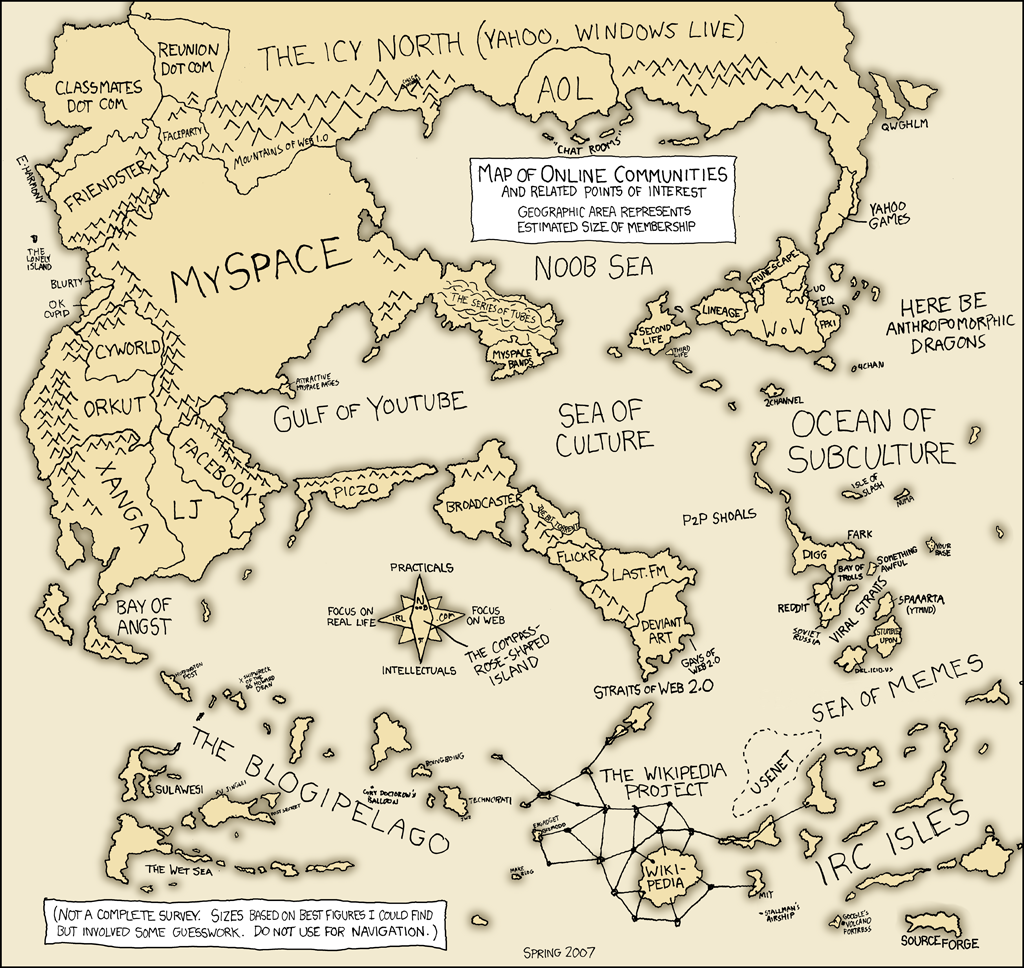
This teenager uploaded a 5 minute video of him babbling on about nothing, yet, this video has 321,106 views. People want to be famous in today’s world more than in past history, and legions of people (including this kid) are taking advantage of that and posting enormous amounts of material onto the “super highway”. The internet can provide information so fast, that billions of people log on from all over the world everyday. To prove my point better than I could write it, I’ll close this blog post with a humorous cartoon map of the online world and its many communities.


Friday, February 13, 2009

Privacy Online?

Social networking sites, such as Facebook and MySpace, have become very popular with people in America and around the world. Sharing pictures, messages, videos and other interactive communication features have grown enormously, especially in the last 4 to 5 years.

Billions of people have access to the internet, which leaves the door open to absues of privacy. Online hackers, child predators and identity theives are a real and often overlooked danger in the online world. Taking this fact into consideration, many people still post personal material very carelessly on these social networking websites. An important fact to consider is that people post this material of their own free will. Many cases have been reported that as a result of certain personal information being revealed on facebook/myspace (such as photos of binge drinking or sexually explicit behavior), they were fired from their job. Employers, professors, and even high school teachers are looking up information on their staffs and students as a new form of background checking.

The lecture in class this week discussed social networking and communities. For example, we learned that Gemeinschaft oriented communities had more of a small town/closely related group feel because of the more solidified social bonds people develop with each other out of the implied trust in their neighbors. Gesellschaft contract societies follow the theory that people are individuals, and as a result of this are free to express their desire to attain personal happiness. Individuals in Gesellschaft are more likely to live in a city or a more urban area because they have isolated themselves and their social bonds in order to preserve their own goals and achievements.

Isolating stronger social bonds, yet gaining many weaker social bonds, is in a way what online and social networking sites are designed to do. Most of the population (at least in the United States) seek out these means of communicating and expressing themselves to trade their stronger social bonds (family, close friends) for Facebook comments and text messages. Technology is rapidly developing as vast amounts of information travels across the internet "super highway" every second. The physical world is interconnected with the online world now, so the same risks of the physical world still apply to the internet world when dealing with privacy rights.

People will most likely continue uploading personal information to Facebook, MySpace and other sites, but it may be at the cost of losing their own privacy.

http://www.cio.com/article/480020/Slapped_in_the_Facebook_Social_Networking_Dangers_Exposed

Friday, February 6, 2009

Future of Adult Education Technology


The U.S. Department of Education has a website for vocational and adult education. The focus of this program is how the web can be used to improve adult education and literacy. Within a digital framework, adult students can receive much needed learning opportunities. Without this new technology, many adults do not have access to educational and training programs that would have an enormous impact on improving their job, economic and social situations.

Digital technologies can now extend educational and training opportunities, which can more quickly and conveniently reach new groups of students, especially an adult population. The new technologies allow for self-paced learning, multi media methods, video tutorials, communications, as well as assessment and guidance.

According to the OVAE (Office of Vocational and Adult Education), digital technologies can improve the quality and scope of an adult education. These methods can increase the learning possibilities for a diverse population of students. Programs can allow for a range of skills and competencies, including language barriers. Digital technologies can develop into online interaction between student and teacher, and also peer-to-peer.

Online distance education has great potential to meet the needs of basic adult education, as well as advanced and specialized learning for students. I believe this is a great advantage of modern technology, particularly in its ability to reach adults who may not have access to other avenues of improving their educational status. This provides a method of learning and training that can have a great impact on a person’s chance for improvement in the modern day work force.